
UAE Extends Emirates Mars Mission — A New Chapter for ‘Hope’ on Mars.
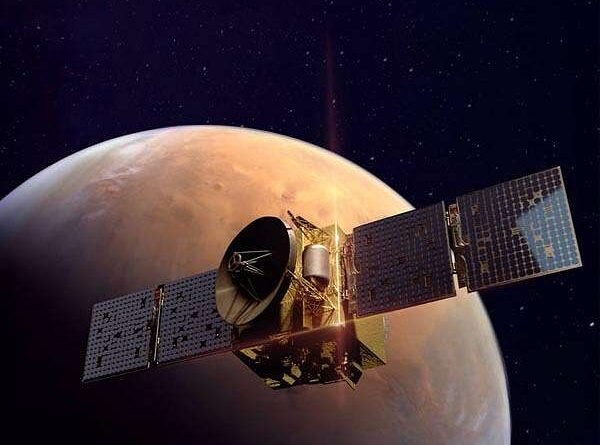
DUBAI-20-02-2026 -The United Arab Emirates (UAE) has announced a significant extension of its landmark Emirates Mars Mission (EMM) — commonly known as the Hope Probe — pushing the mission’s operations until 2028, three years beyond its originally planned end date. This decision reflects not only the probe’s exceptional performance but also the UAE’s commitment to space science, global collaboration, and building a robust national space ecosystem.
Origins of a Historic Mission
The Hope Probe was launched on 20 July 2020 from Japan’s Tanegashima Space Center aboard an H-IIA rocket, becoming the first interplanetary mission led by an Arab nation and only the fifth mission in history to successfully enter Martian orbit.
Initially designed as a two-year mission, it arrived at Mars on 9 February 2021 to study the Red Planet’s atmosphere, climate cycles and weather patterns more comprehensively than ever before. Its scientific goals included examining how hydrogen and oxygen escape into space, monitoring dust storms, and revealing links between the lower and upper atmospheric layers.
Outstanding Scientific Achievements
Over more than five years in orbit, the Hope Probe has far exceeded expectations:
- More than 10 terabytes of data collected — a massive contribution to Martian climatology and atmospheric studies.
- Detailed insights into seasonal weather patterns, climate history and auroras on Mars, enriching understanding far beyond the mission’s original objectives.
- The probe even captured ultraviolet images of the interstellar comet 3I/ATLAS when this rare object passed through the inner solar system — a rare observational achievement that Earth-based telescopes missed.
- Continuous high-resolution observations of Mars’ smaller moons, like Deimos, and records of dynamic atmospheric processes are shaping how planetary scientists model Martian environments.
The data from Hope is freely available to researchers worldwide and has been used in hundreds of scientific collaborations, reinforcing its value as an open source of planetary knowledge.
Why the Extension Matters
Extending the mission through 2028 offers several important benefits:
1. Deeper Atmospheric Insights
Mars’ atmosphere is influenced by complex seasonal and interannual changes. Continued long-term monitoring helps scientists understand how the planet’s climate evolves over multiple Martian years — a key to both comparative planetary science and modelling atmospheric physics more generally.
2. Maximizing Scientific Return
Hope’s instruments remain fully operational and continue to deliver high-quality data. Extending the mission ensures that the UAE’s substantial investment in space science yields even greater scientific returns — building a legacy far beyond the original mission’s timeline.
3. Strengthening UAE’s Space Ecosystem
The Mars mission has been more than a scientific experiment — it has been a catalyst for national capability building. Since the mission’s inception:
- The number of space-related entities in the UAE has grown significantly, with increased private sector participation and educational investment.
- Interest in STEM education among students across the region has risen as young people see direct opportunities in space science.
- Operational experience gained from Hope paves the way for future missions, such as the planned Emirates Mission to the Asteroid Belt, set for launch in 2028.
A Strategic, Long-Term Vision
UAE space officials — including Dr. Ahmad Belhoul Al Falasi, UAE’s Minister of Sports and Chairman of the UAE Space Agency — have emphasized that this extension aligns with the nation’s long-term strategy to:
- Empower national talent in high-tech sectors.
- Position the UAE as a global partner in space research.
- Build a diversified, knowledge-based economy.
Rather than being a symbolic achievement, the Hope Probe has become a functioning physics laboratory in Martian orbit — one that continues to push boundaries in planetary science.
Looking Ahead
With operations extended to 2028, the Hope Probe is poised to continue shaping our understanding of the Red Planet. Its success highlights how medium-scale missions from emerging space nations can make outsized contributions to global science. As the UAE prepares for future missions — including ventures beyond Mars into the asteroid belt — the Hope Probe’s extended mission stands as a testament to international cooperation, enduring scientific curiosity, and visionary space policy.