
Spectacular Planetary Parade Dazzles Dubai Skies This Ramadan
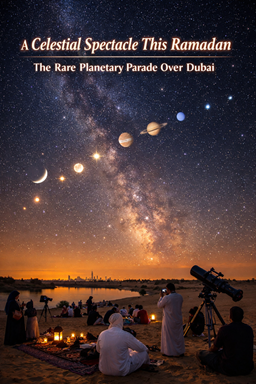
DUBAI 21-02-2026 -This Saturday evening — 21 February 2026 — skywatchers in the United Arab Emirates are in for an extraordinary astronomical event: a rare planetary parade visible just after sunset over the Al Qudra Desert in Dubai during Ramadan. Hosted by the Al Thuraya Astronomy Centre, the event combines science, culture, and community under the stars.
What Is a Planetary Parade?
A planetary parade refers to a moment when several planets in our Solar System appear close together in the sky as seen from Earth. Although the planets don’t actually form a straight line in space, from our perspective they appear arranged in a sweeping arc along the ecliptic plane — the flat path that most planets follow around the Sun.
This optical alignment happens because each planet orbits the Sun at a different speed — for example, Mercury completes its orbit in just 88 days, while Saturn takes nearly 29 years. The rare chance that many planets occupy compatible positions simultaneously makes such parades special, especially when six planets become visible together.
For a scientific explanation of planetary alignments, you can explore:
- NASA Solar System Exploration: https://solarsystem.nasa.gov
- European Space Agency (ESA) Astronomy Portal: https://www.esa.int
- Time and Date – Planetary Alignments Guide: https://www.timeanddate.com/astronomy/planets/
The Planet Lineup: Who’s in the Parade?
On the night of the event, the sky over Dubai will showcase six planets, each visible to varying degrees:
- Venus – The brightest object after the Moon and Sun, easily seen with the naked eye.
- Jupiter – Brilliant in the sky; its cloud bands can be seen through a telescope.
- Saturn – Visible shortly after sunset; a telescope reveals its iconic rings.
- Uranus & Neptune – The distant ice giants usually require a telescope or strong binoculars to be seen.
- Mercury – Often tricky due to its proximity to the Sun but possible to catch low on the horizon with binoculars.
This arrangement offers both casual observers and experienced astronomers a spectacular view — combining bright, easy-to-see planets with fainter worlds that demand optical aid.
For sky charts and real-time tracking, you can use:
- Stellarium Web: https://stellarium-web.org
- Sky & Telescope Observing Tools: https://skyandtelescope.org
Where and When to Watch
- Location: Al Qudra Desert — a part of the Al Marmoom Desert Conservation Reserve, chosen because its dark, open skies are ideal for observing faint celestial objects away from city light pollution.
- Time: Shortly after sunset (around 6 pm) — best viewing begins about 30–45 minutes after sunset, as twilight dims and the planets climb above the horizon.
- Day: Saturday, 21 February 2026, during the holy month of Ramadan.
Clear skies, an unobstructed view to the west, and arriving early will improve your chance to spot the planets in sequence from low to high in the sky.
A Fusion of Faith, Science, and Community
What makes this year’s event particularly poignant is its timing during Ramadan — a period when Muslims observe fasts, gather for Iftar, and reflect under the night sky. Organisers have woven this cosmic event into the spiritual fabric of the month:
- The evening begins at 6 pm with an introduction.
- Iftar and Maghrib prayer follow at around 6:20 pm, a meaningful pause where participants break their fast together.
- Early planet viewing (especially Saturn) starts around 6:45 pm, before it descends toward the horizon.
- Expert talks explore the science behind the Islamic lunar calendar, the historic practice of moon sighting, and the dynamics of planetary motion.
- After a dedicated presentation on the parade at about 7:45 pm, telescopes remain open for deeper exploration of the Moon, Jupiter, and other celestial objects.
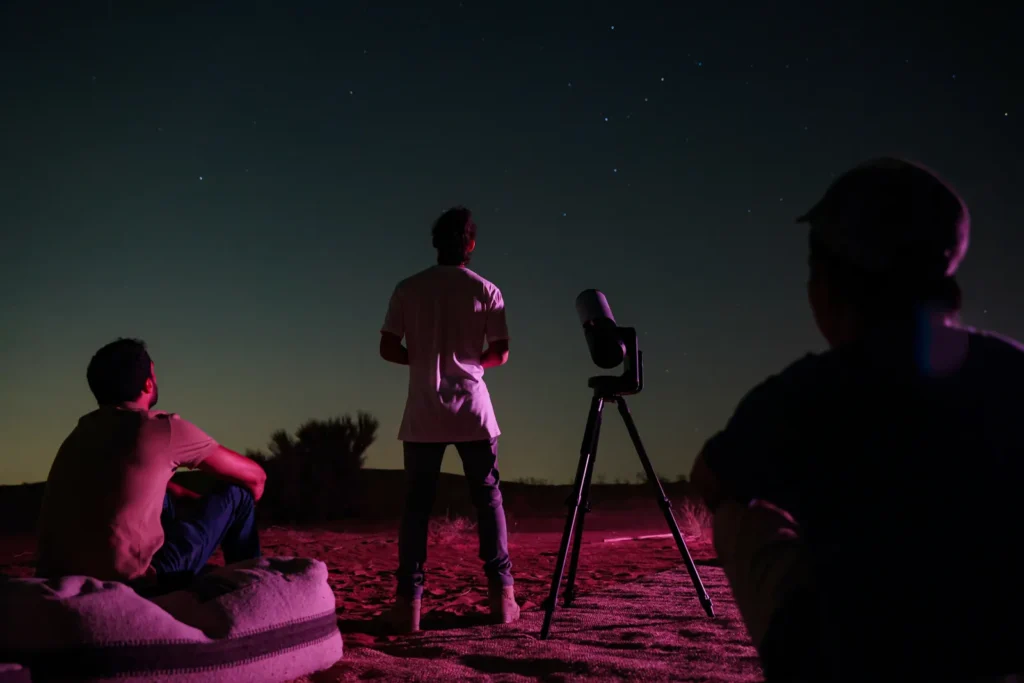
- By 9:30 pm, attendees can enjoy free telescope viewing of deep-sky objects and even capture shots using smartphone adapters through the lenses.
This blend of astronomy education, spiritual reflection, and outdoor community engagement makes the event more than just a skywatching spectacle — it’s a shared experience of wonder and connection.
Tips for Viewing and Photography
To get the most out of this celestial parade:
- Bring binoculars or a telescope — Venus, Jupiter, and Saturn are bright, but Uranus, Neptune, and Mercury may need magnification.
- Choose a low horizon point west-southwest — where the planets will line up as twilight fades.
- Use a tripod and phone adapter for steady astrophotography. Many attendees will try capturing the line of planets and other deep-sky objects through telescopes.
Why It Matters
While planetary alignments happen periodically, seeing six planets together in one sweep across the evening sky is a rare treat. It’s not just a beautiful visual — it’s a reminder of the dynamic nature of our Solar System and our place within it.
For residents and visitors in the UAE, this combination of science, culture, and desert landscape offers an unforgettable night under the stars — a cosmic celebration that mirrors the introspective spirit of Ramadan itself.